
The five places your Shopify store leaks money before you spend more on ads
The cheapest growth is the traffic you're already paying for. The five places a Shopify store leaks money, and the order we'd fix them first.

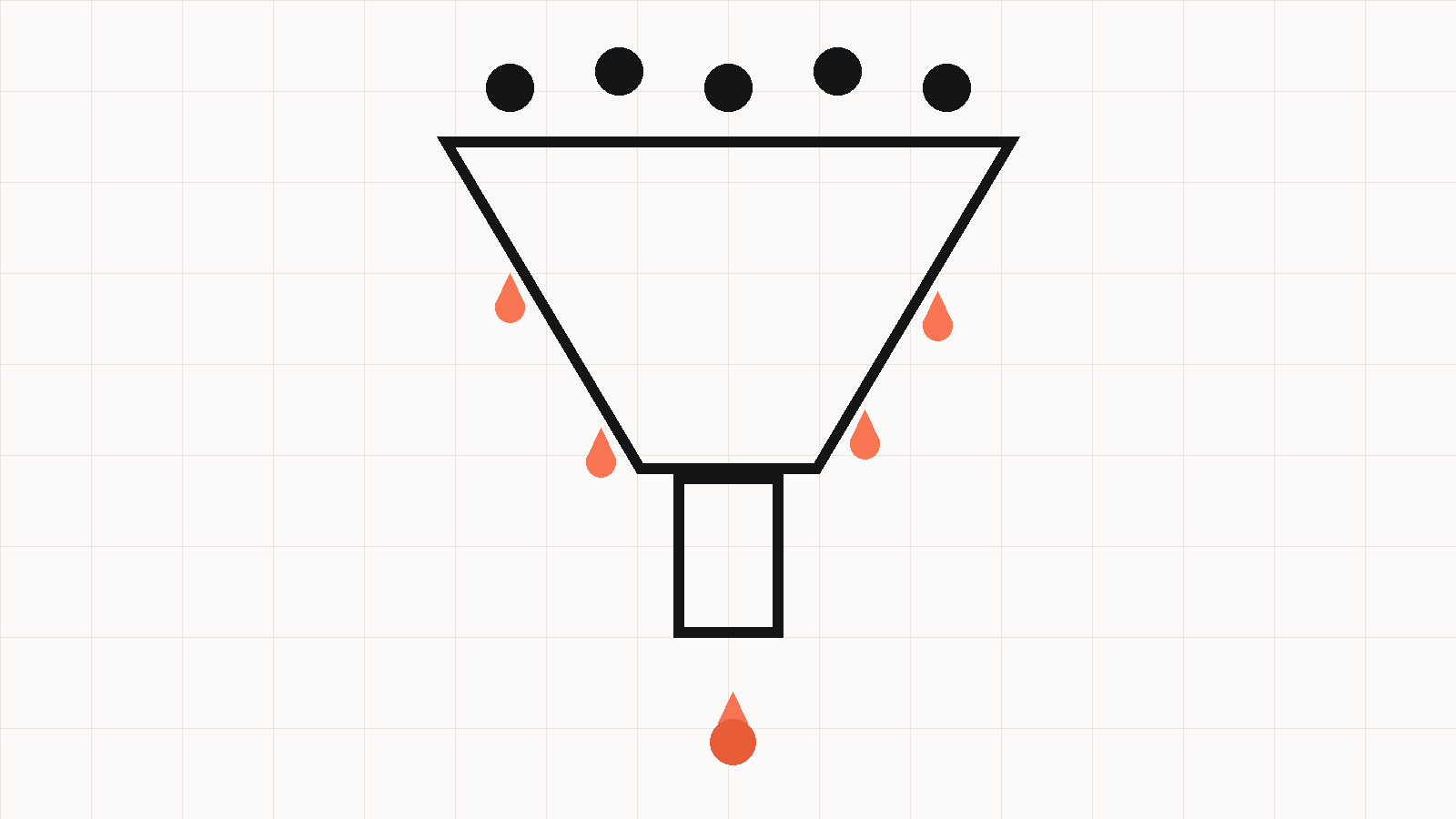
When growth stalls, the first instinct is usually to buy more traffic. It is the wrong first move more often than not. Before you raise the ad budget, check the store is not losing a good share of the visitors it already has. That traffic is paid for, so getting more out of it is the cheapest growth there is. It is also why we do conversion work before recommending anyone spends more.
Here are the five places we look, roughly in the order they turn out to be the actual problem.
1. The checkout
This is the surface that moves the most money on the store, and the one most often broken. Forced account creation before someone can pay. Shipping cost that only shows up on the final step, after they have committed to a lower number in their head. A five-field form where two would do. Each of these sheds buyers who had their card out. We start here because a checkout fix converts people who had already decided to buy, which is the fastest money in the building.
2. The product page
Most product pages ask the visitor to want the thing without giving them enough to decide. The information that closes a sale often sits below the fold or is missing: returns terms, delivery times, sizing, the answer to the one objection every buyer has. If a shopper has to hunt for whether they can send it back, some of them just leave.
The cheapest customer is the one already on your site. Most stores spend to replace them instead of keeping them.
3. Speed
A slow store loses a little money on every visit, and Shopify makes it easy to get slow without noticing. Apps stack up, each adding its own scripts, and a page that used to load in two seconds takes five. On mobile it is worse. Speed is not only a conversion issue either. It feeds rankings too, which is part of why we do not treat SEO and CRO as separate jobs.
4. Mobile
Most D2C traffic is on a phone, and most stores are still built and checked on a desktop. The desktop layout looks great in a design review, then the mobile version buries the add-to-cart button under three thumb-scrolls of hero image, or puts the discount box right where people fat-finger it. Test the phone experience as if it is the main one, because for your customers it is.
5. On-site search and navigation
When someone uses your search bar, they are telling you exactly what they want to buy. If the results are poor, or the category structure makes them dig, you lose a visitor who arrived with intent. This one hides because it only touches a slice of traffic, but that slice converts higher than average, so the losses cost more than they look.
Where this leaves you
Fix the leaks in that order and every other channel gets more profitable at once, because you are paying the same to acquire a visitor and keeping more of them. That is the case for conversion work before bigger ad budgets rather than after, and it is why CRO sits at the centre of how we run things rather than off to the side. If you are about to spend more on ads, make sure the store is ready to keep what you send it. That is a fit call.
Common questions
What is a good ecommerce conversion rate?
Most Shopify stores sit somewhere in the low single digits, but your own trend matters more than any benchmark. Moving from 1.2% to 2.4% is the same as halving your cost of acquisition, whatever the average happens to be.
Should I do CRO or spend more on ads?
Usually CRO first. If your store converts at 1.5%, more traffic just means paying to lose people faster. Fix the conversion rate and the ads you already run get cheaper on the same spend.
How long does CRO take to show results?
Checkout and product-page fixes can move the number within weeks. Bigger structural work is slower. Either way it keeps paying off, because every improvement applies to all your traffic, not just the next campaign.
Nathan came to digital marketing a decade ago via sales, nursing and kitchen management, which all turn out to be the same job: solving problems under pressure. Where Andy builds for business, Nathan builds for people, and if an idea is good enough he will not sleep until it is live.